
Quick answer
A mid-pack foundation repair shop closes 38% of inspections. A top-quartile shop closes 52% on the same lead volume. The 14-point gap is worth +$1.1M of revenue at a $3M company without one new dollar of marketing spend. The leak is rarely the price sheet. It traces to 4 spots: no same-day proposal, weak photo-documentation, no follow-up cadence past touch 1, and no system to resurrect estimates that go cold. This piece walks each one. Then names the fix.
The 14-point gap that decides whether a foundation repair owner makes $250K or $70K
There’s a moment in every foundation repair owner’s month where the inspection report comes back, the homeowner says “let me think about it,” and the owner moves on to the next lead. That moment is where most of the year’s gross profit walks out the door.
The industry benchmark from Clicks Geek’s foundation repair contractor data puts inspection-to-sale close rates between 35 and 55 percent. Insurance-tied structural work runs higher, “north of 70 percent” per BellaFSM’s industry data. The spread between bottom-quartile and top-quartile is roughly 17 points on the same lead volume, the same crew, and the same metro.
That spread is not pricing. It’s not the homeowner’s budget. It’s not the market.
It’s the estimate-to-close process. Most operators are running one. They just don’t know it’s the broken one.
This piece walks the 4 reasons foundation repair estimates die after the inspection, the math on each one, and what the operators clearing 52%+ are doing that the 38% crowd isn’t. The numbers below are conservative. Your shop is probably worse on at least 2 of the 4.
Let’s start with the close rate itself.
What is a good close rate for foundation repair?
50 to 55 percent on inspected leads is the top-quartile target. 38 to 45 percent is where most mid-pack shops sit. Anything under 30 is a process problem, not a market problem.
The benchmark range comes from Clicks Geek’s foundation repair contractor data: inspection-to-sale close rates run 35-55 percent across the industry. The top of that range is where the operators with structured processes live. The bottom is where the “we just inspect and quote” shops live.
Two factors swing close rate harder than anything else in foundation repair:
- Job type. Insurance-tied structural work (settlement claim, hurricane damage, plumbing-failure-triggered foundation issue) closes “north of 70 percent” per BellaFSM industry data because the homeowner has insurance pressure to act. Cash-paid mitigation work (basic pier installs, crack injection, slab leveling) closes in the 35-45 percent range because the homeowner is making a discretionary capital decision.
- Same-day proposal vs. follow-up proposal. Shops handing the homeowner a priced, signed-ready proposal on the same site visit close at roughly 50-60 percent. Shops emailing the proposal 2-5 days later close at 25-35 percent. Same job. Same homeowner. Different process. The drop happens because the homeowner cools, gets a competing quote, or simply moves the foundation issue down the priority list.
The shops winning the close rate war aren’t price-cutting. They’re running a tighter process from inspection through proposal through follow-up. The math compounds across the year.
Let’s walk the leaks.
Why do foundation repair estimates die after the inspection?
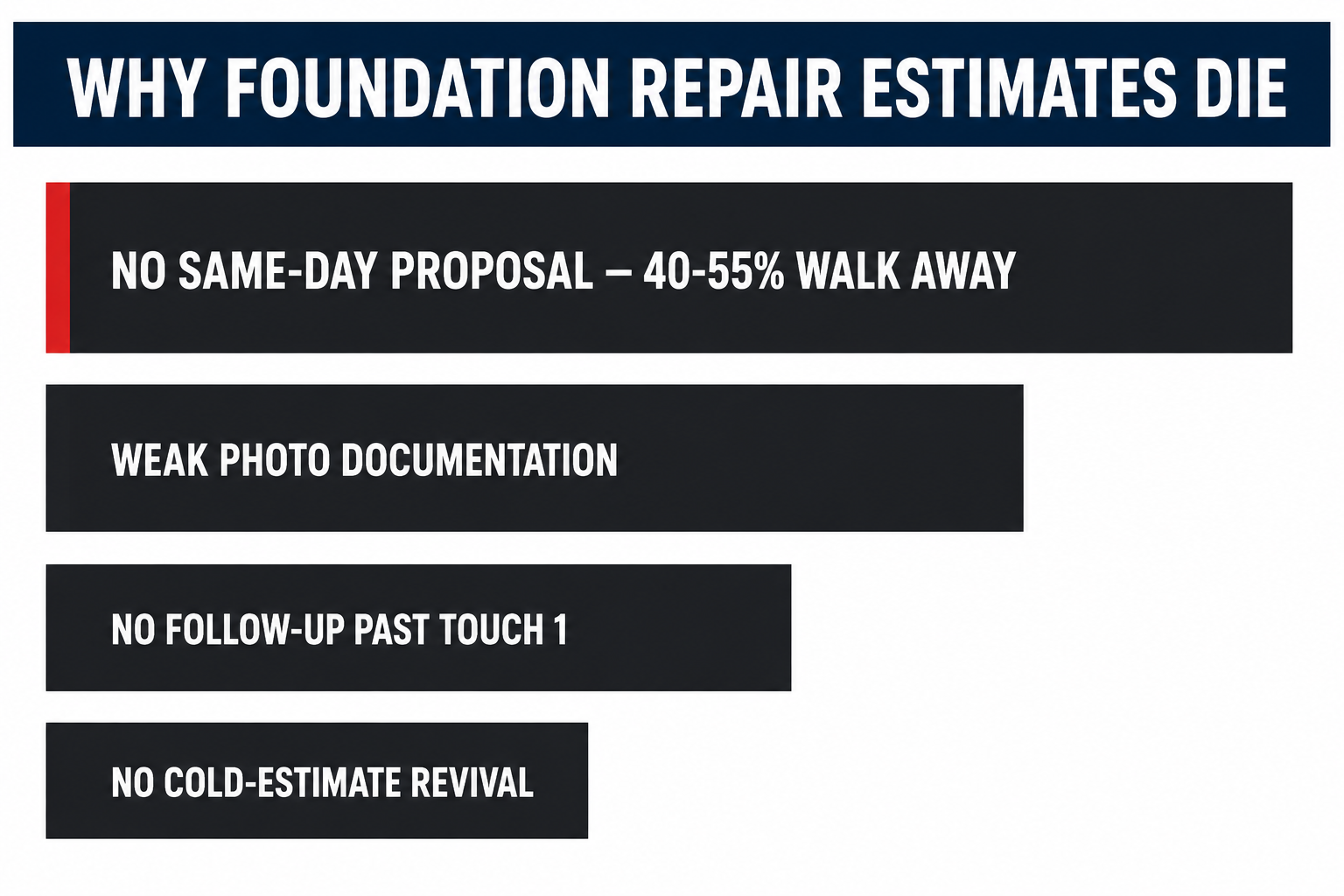 Four reasons, in order of how much money each one drains.
Reason 1: No same-day proposal. The estimator inspects, takes notes, says “I’ll send a proposal tomorrow.” Tomorrow becomes 3 days. The homeowner calls the next foundation company on the search list and gets a same-day quote. Walk-away rate on delayed-proposal jobs runs 40-55 percent.
Reason 2: Weak photo-documentation in the proposal. The proposal arrives as a PDF with a scope of work, a price, and a logo. No photos of the crack pattern. No photos of the moisture line on the wall. No photos of the pier locations marked on a foundation diagram. The homeowner has nothing to validate the price against. The proposal feels like a number pulled from thin air, so the homeowner shops it.
Reason 3: No follow-up cadence past touch 1. The proposal goes out. The estimator emails once 3 days later: “Just checking in.” The homeowner doesn’t reply. The estimator marks it “no response” and moves on. Industry-tracked follow-up data shows 80 percent of sales require 5 or more touches, yet most foundation operators send 1 follow-up before quitting.
Reason 4: No system to resurrect estimates that go cold. Builder Prime’s contractor data shows 60-70 percent of leads don’t convert on first contact, but at least half of those homeowners purchase within the year. Most foundation operators never re-touch a cold estimate. The job that didn’t close in week 1 gets forgotten. The homeowner buys from a competitor 4 months later because the competitor was the only one still in the inbox.
Each one of these reasons shaves points off close rate. Stacked, they’re the difference between 38% and 52%.
How long should a foundation repair estimate take?
Inspection-to-signed-proposal should clear inside the same site visit when possible, and inside 24 hours when not. The data on this one is stark.
Builder Prime’s contractor case data shows contractors who follow a structured cadence routinely double their conversion rate against shops sending one email and waiting. The cadence is the variable, but the front edge of the cadence (the time from inspection to first proposal in the homeowner’s hand) is what determines whether the rest of the cadence even matters.
Here’s the dynamic. A homeowner with a foundation issue is in a panic-research mode. They Googled, picked 3 contractors, scheduled 2 inspections, and are mentally deciding by the time the second inspection ends. If the first contractor handed them a signed-ready proposal on site and the second contractor said “I’ll send a proposal Friday,” the first contractor wins 60-70 percent of those decisions regardless of the price gap.
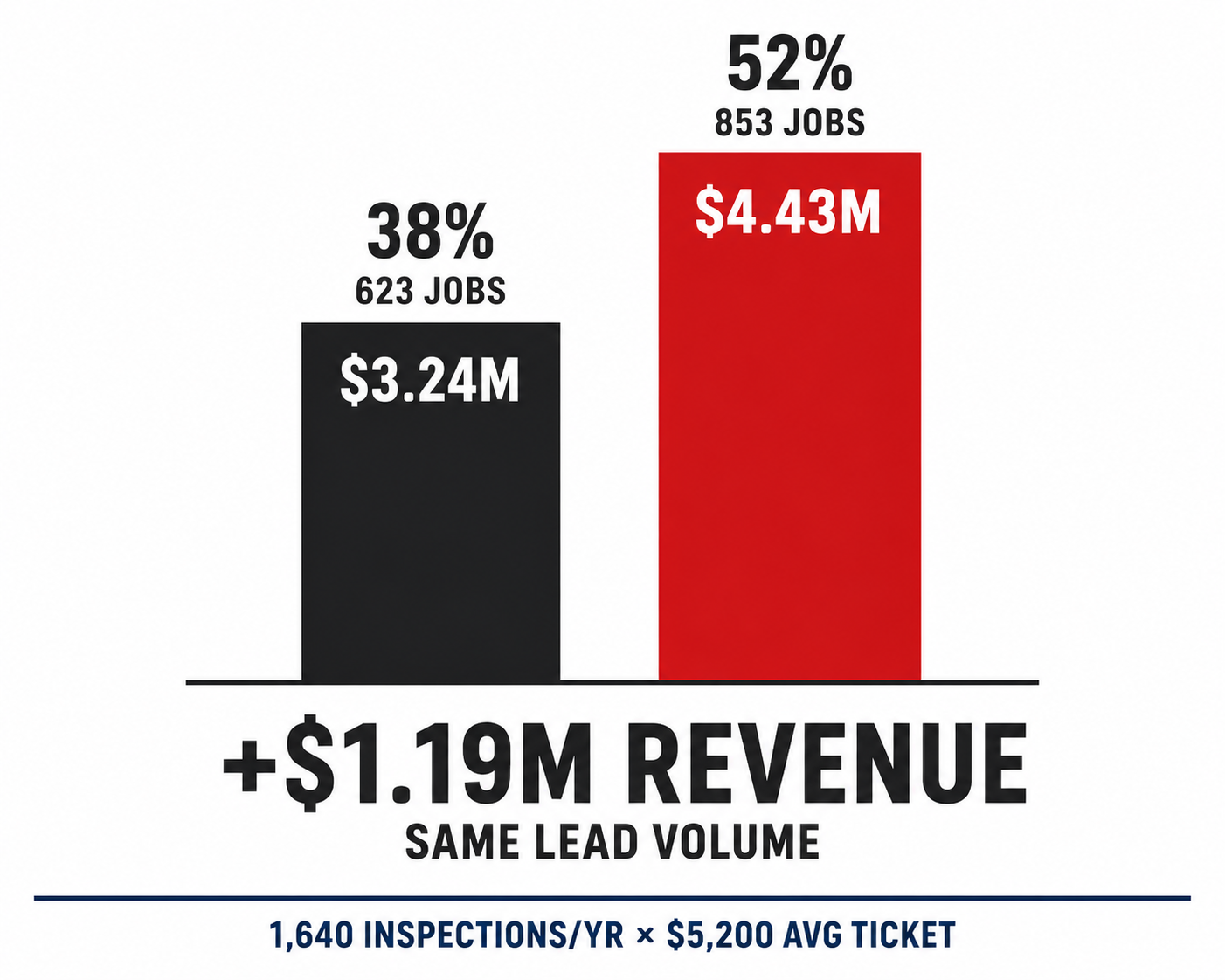
Worked at a $3M shop running 1,640 inspections a year:
- Same-day-proposal shop closing at 52%: 1,640 × 52% = 853 jobs × $5,200 (Angi 2026 average ticket) = $4.43M revenue
- Delayed-proposal shop closing at 38%: 1,640 × 38% = 623 jobs × $5,200 = $3.24M revenue
- Same lead volume. Same crew. +$1.19M of revenue from one process change.
At 55-65 percent margin on mitigation-stage line items, the same-day-proposal shop pockets roughly $655K to $774K of additional gross profit per year. For the cost of equipping every estimator with a tablet and a templated proposal-builder.
Most foundation owners don’t run same-day proposals because the office is the bottleneck. The estimator scribbles on a clipboard, drives back, hands the notes to an office manager, the office manager builds the proposal in Word, the proposal goes through 2 rounds of edits, and 3 days later it lands in the homeowner’s email. The fix isn’t the estimator. The fix is removing the office-manager step.
Make sense?
Should foundation contractors close on site?
Yes when the job is straightforward. Maybe when the scope is complex. The default should be “always try.”
Here’s the framing. Same-day close requires 3 things in the truck: a tablet with a proposal-builder, a price book the estimator can run on the spot, and a signature capture. If those 3 are in the truck, the close rate on the on-site offer runs 50-60 percent on basic pier work and slab repair.
The shops that don’t close on site usually fail on one of those 3 inputs. The tablet is the easy one. The price book is the harder one because most foundation owners want to “review the scope” before quoting. The signature capture is trivial once the first two are in place.
The owners I’ve talked to in the $1M-$5M range who installed on-site closing in the last 18 months saw close rates lift 8-15 points inside a quarter without changing any other variable. Same crew, same marketing, same intake. Just the proposal in the homeowner’s hand before the truck leaves.
For complex jobs (full underpinning, basement waterproofing tied to an insurance claim, structural reinforcement requiring engineer sign-off) the on-site close is harder. The right play there is a same-day proposal sent within 4 hours of the inspection, paired with a scheduled follow-up call within 24 hours to walk the homeowner through it.
Either way, the principle is the same: speed from inspection to proposal-in-hand is the single highest-leverage variable in the close-rate equation. The shops winning aren’t price-cutting. They’re moving faster.
How do you follow up after a foundation repair estimate?
A structured 7-touch sequence across SMS, email, and personal call across 21 days. The exact cadence matters less than the discipline of running one at all. Most operators run zero.
Here’s the touchpoint stack the top-quartile foundation operators are running on every estimate that doesn’t close on site:
| Touch | Day | Channel | Message intent |
|---|---|---|---|
| 1 | Hour 4 | SMS | “Hi [Name], here’s the proposal we walked through. Two questions on the scope when you have a sec.” |
| 2 | Day 1 | Proposal PDF + 3 photos from inspection + short video walkthrough | |
| 3 | Day 3 | SMS | “Quick question on the proposal, any concerns I can address?” |
| 4 | Day 5 | Personal call | Live conversation, address objections, offer to walk through anything |
| 5 | Day 8 | Case study or photo gallery of a similar job already completed | |
| 6 | Day 14 | SMS | “Wanted to follow up, still considering or did you go with someone else?” |
| 7 | Day 21 | Personal call | Final touch, soft offer to revisit pricing or scope if needed |
This is the sequence Builder Prime’s contractor case data is built on. Contractors running a structured cadence routinely double conversion against shops sending one follow-up. A well-run rehash program against the missed-close pile can generate $1M+ in additional annual sales for a mid-pack shop.
The math at a $3M foundation shop running this sequence:
- Current state: 1,640 inspections × 38% close = 623 jobs × $5,200 = $3.24M
- 7-touch sequence applied to the 1,017 inspections that didn’t close on first proposal
- Resurrection rate per industry tracking: 12-18% of cold estimates close on the cadence
- 1,017 × 15% = 153 additional jobs × $5,200 = $796K of additional revenue
- At 55-65% margin = $438K to $517K of additional gross profit
The reason this works: the homeowner who said “let me think about it” usually wasn’t lying. They were genuinely thinking about it, got busy, forgot, and never circled back. The cadence is what brings them back. Not pressure. Not discounts. Just presence.
Most foundation owners don’t run this sequence because nobody on the team has time to send 7 manual touches across 21 days for every cold estimate. That’s the real bottleneck. The sequence has been understood as best practice in sales for 30 years. Execution discipline is what’s missing.
That’s where automation enters the conversation, and it’s the first time AI matters in this piece.
How can foundation repair owners close more estimates without hiring another salesperson?
By installing 3 systems on top of whatever CRM the shop already runs. Same-day proposal capability, photo-documentation that travels with the proposal, and an automated 7-touch follow-up sequence that runs without a human pushing send.
System 1: Tablet-based proposal-builder in every estimator’s truck. Templated scope, dropdown price book, signature capture, instant PDF generation. Cost: $100-200/month per seat. Lift: 8-15 close-rate points within a quarter.
System 2: Photo-documentation auto-attached to every proposal. Estimator takes 8-12 photos on the inspection (crack pattern, moisture line, pier locations, soil grade, drainage path). The proposal-builder pulls them into a labeled gallery the homeowner can scroll through. AI-assisted photo-categorization (auto-tagging which photos show which damage type, auto-matching to scope-of-work line items) didn’t exist for foundation shops 24 months ago. It exists now.
System 3: Automated 7-touch follow-up sequence on every cold estimate. SMS, email, and personal-call prompts triggered by date inside the CRM. The personal-call touches still need a human, but the 5 SMS-and-email touches run without anyone pushing send. The CRM tracks every reply, escalates hot replies to the estimator inside 5 minutes, and re-queues cold estimates into the next quarter’s reactivation pile.
All 3 systems exist as off-the-shelf tools. None of the 3 require hiring a new salesperson. All 3 are now standard tooling for foundation shops doing $2M+, and barely deployed at shops doing under $1M.
This is what “AI for foundation repair” actually means in 2026. Not a chatbot on the website. Not a magic close-the-job machine. Three specific automations that compress the time from inspection to signed proposal, give the homeowner enough visual proof to validate the price, and keep the sequence running on cold estimates until the homeowner either signs or hard-no’s.
The estimate leak is one of five. For the lead-leak side of the pipeline, the calls that never make it to an inspection in the first place, see Why 85% of Callers Never Call Back. For the full map of where service-business revenue quietly exits, see The 5 Revenue Leaks Killing Your Service Business Right Now. And if the honest answer to “who runs the 7-touch sequence” is “nobody has time,” the cost math on solving that with a person versus a system is here: AI Voice Agents vs. Hiring a Receptionist.
What’s the fastest way to find your estimate-to-close leak?
Pull 90 days of data on 4 things: total inspections completed, jobs closed on site, jobs closed 1-21 days post-inspection, jobs marked “no response” or “lost.” Calculate the percentages. The biggest leak will be obvious inside 10 minutes.
Most owners don’t have this data clean. They have a CRM stage called “inspected,” a stage called “won,” a stage called “lost,” and a wide gap of “no response” estimates that nobody’s looking at. That gap is usually the entire $1.1M opportunity sitting hidden.
The free 5-pillar audit we built does exactly that calculation. It pulls the CRM stages, the calendar of inspections, the proposal-sent dates, and the won/lost ratios, runs them against the verified industry benchmarks above, and tells you in plain dollar terms how big your estimate-to-close leak is right now and which of the 4 reasons is draining it most. 10 minutes to set up. Numbers in your inbox.
Run your free AI Revenue Audit and see exactly where your foundation repair estimates are dying:
https://audit.surgetick.com/?utm_source=blog&utm_medium=organic&utm_campaign=surge_may26
The numbers in this article are industry averages. Yours will be different. The 14-point gap between mid-pack and top-quartile is real money sitting inside the same business you’re already running.
FAQ
What is a good close rate for foundation repair?
50 to 55 percent on inspected leads is the top-quartile target per Clicks Geek’s foundation repair contractor data, which puts the industry range at 35-55 percent. Insurance-tied structural work runs higher, “north of 70 percent” per BellaFSM industry data. Most mid-pack shops sit at 38-45 percent. The gap between mid-pack and top-quartile is rarely pricing. It’s the estimate-to-close process: same-day proposals, photo-documentation, and a structured 7-touch follow-up sequence on every cold estimate.
How can contractors close more estimates?
Three highest-impact moves: (1) deliver a signed-ready proposal on the same site visit using a tablet-based proposal-builder in every estimator’s truck, (2) attach 8-12 photos to every proposal so the homeowner can validate the scope against visual proof of damage, (3) run an automated 7-touch follow-up sequence across SMS, email, and personal call across 21 days on every estimate that doesn’t close on site. Builder Prime data shows contractors running a structured cadence routinely double their conversion rate vs. shops sending one follow-up.
What is the inspection-to-sale rate for foundation repair?
35 to 55 percent across the industry per Clicks Geek. Top-quartile shops with same-day proposals and structured follow-up sequences run at the upper end (50-55%) or higher on insurance-tied structural work (70%+ per BellaFSM). Mid-pack shops with delayed proposals and single-touch follow-up run at the lower end (35-45%). The 14-point gap between bottom and top quartile is worth $1.1M of revenue at a $3M shop on the same lead volume.
How long should a foundation repair estimate take?
Inspection-to-signed-proposal should clear on the same site visit when the scope is straightforward. For complex jobs (full underpinning, insurance-tied structural work, engineer-required scope), the proposal should be in the homeowner’s email inbox within 4 hours of the inspection, paired with a scheduled follow-up call inside 24 hours. The dynamic: a homeowner with a foundation issue is in panic-research mode and is mentally deciding by the time the second inspection ends. The first contractor to put a signed-ready proposal in their hand wins 60-70% of those decisions.
Should foundation contractors close on site?
Yes when the job is straightforward. The setup requires 3 things in the truck: a tablet with a proposal-builder, a price book the estimator can run on the spot, and a signature capture. Shops that installed on-site closing in the last 18 months saw close rates lift 8-15 points inside a quarter without changing crew, marketing, or intake. For complex jobs, same-day-emailed proposal + 24-hour follow-up call is the fallback. Either way, speed from inspection to proposal-in-hand is the single highest-leverage variable in the close-rate equation.
How do you follow up after a foundation repair estimate?
A structured 7-touch sequence across SMS, email, and personal call across 21 days: SMS at hour 4, email with proposal at day 1, SMS at day 3, personal call at day 5, email with case study at day 8, SMS at day 14, final personal call at day 21. Industry follow-up data shows 80% of sales require 5+ touches, yet most foundation operators send 1. The 12-18% of cold estimates that close on a structured cadence are worth $438K-$517K of additional gross profit per year at a $3M shop. The 5 SMS-and-email touches run on automation; the 2 personal calls still need a human.
[…] Estimate-to-close follow-up. Most shops send one email after the inspection. The job is done in the 7-touch sequence. See the breakdown on the estimate-to-close bottleneck. […]