
By Edem Agbley | Published May 2026
Quick Answer: AI for small business in 2026 is widely talked about and barely used. Goldman Sachs found 76% of small businesses claim to use AI, but only 14% have it built into core operations. The gap costs the average shop $126,000 a year in missed calls alone.
Want a real number on what your business is leaking right now? Book a Free AI Revenue Audit and we’ll pull your actual call logs, lead response times, and follow-up gaps. No deck. No pitch. Numbers.
Tom owns a plumbing shop in suburban Chicago. Doing $1.4M a year. Two trucks. A wife who answers calls between school pickups.
Tom isn’t dumb.
Tom has read every “AI is the future” piece for two years. Subscribed to three newsletters. Watched a Saturday-morning YouTube on ChatGPT in 2024. He still doesn’t have a single AI tool actually running in his business. And last fall he watched a competitor across town go from 4 trucks to 9 in eighteen months.
Tom is the 80%.
He’s not behind because he’s slow. He’s behind because every AI vendor on earth has been selling him the engine, when all he ever wanted was a way to stop bleeding $9,400 a month on phones his wife can’t get to in time.
What does the AI adoption gap actually look like in 2026?
The AI adoption gap is the distance between owners who claim to use AI and owners who actually run it inside their business. Goldman Sachs surveyed small business owners in early 2026 and found 76% reported using AI in some way. Only 14% had fully integrated AI into core operations.
Read that twice.
Three out of four owners say “yeah, we use AI.” One out of seven actually runs it through anything that touches money. Phones, follow-up, scheduling, billing, intake. The other 62% are using ChatGPT to rewrite an email once a week and calling that a strategy.
The federal numbers are even uglier. The SBA Office of Advocacy, pulling from the Census Business Trends and Outlook Survey, reported 8.8% of small businesses (under 250 employees) used AI in production as of August 2025. Up from 6.3% six months earlier, sure. Still single digits.
So when you hear “everyone’s using AI in 2026,” translate: a tiny minority are actually running it where it matters.
Why are most small business owners stuck in the 80%?
Most owners are stuck because the AI industry has been selling them the wrong thing for two years. Goldman Sachs found that 73% of small business owners say they need more training and support to actually use AI. SurgeTick’s pre-verified data shows 46.8% list lack of knowledge as the #1 barrier.
Knowledge isn’t the real problem though.
The real problem is that nobody is selling Tom the plumber a way to recover the $9,400 a month his shop loses to missed calls. They’re selling him “AI-powered solutions” with a 47-feature dashboard and a 30-day onboarding. Tom doesn’t have 30 days. Tom has a Tuesday.
Here’s the scar I think about every week. A contractor I talked to last spring told me his wife sat in their truck at 11pm in October trying to figure out why their “AI assistant” kept booking jobs into times he was already on another call. He paid $1,800 to a guy on Upwork to set it up. The thing didn’t sync to his actual calendar. He killed it after 3 weeks. Now when he hears “AI” he hears somebody trying to sell me another thing that won’t work.
That’s the 80%. They aren’t lazy. They’re scarred.
What is the cost of doing nothing about AI in 2026?
The cost of doing nothing is bigger than most owners realize, and it shows up first in missed calls. Service businesses miss 27–62% of inbound calls. 85% of callers who don’t reach a live person never call back. The average small business loses $126,000 a year to unanswered phones alone.
That’s a Toyota Camry every year, lit on fire.
But the bleeding doesn’t stop at the phone. A landmark Harvard Business Review study by James Oldroyd at MIT, analyzing 15,000 leads and 100,000 call attempts, found that businesses responding to a lead within 5 minutes were 100 times more likely to make contact and 21 times more likely to qualify than businesses that waited 30 minutes. Most service shops respond in hours. Some in days.
The 5-minute window closes while you’re under a sink.
So when somebody tells you “AI doesn’t really apply to my business,” ask them how many calls they missed last week. Ask them how long the last new lead waited for a callback. (And yes, I check the call logs on every contractor I audit, and the gap between “I think we get back fast” and the actual median response time is 4 hours or more, every time.) The math on doing nothing is brutal. It just doesn’t show up on a P&L line called “missed.”
What does AI actually look like for a small service business?
For a small service business, AI looks like one specific job done for you, automatically, every time. An AI voice agent answering after-hours calls. A follow-up sequence texting every lead in 90 seconds. A scheduling system that books jobs without your wife playing phone tag at 9pm.
Not a dashboard. A job.
The shops that actually run something, even one thing, are pulling away from the shops that don’t. I’ve sat across from owners on both sides of that line. The one with a voice agent picking up overflow calls is booking work he was leaving on the table last year. The one still “getting around to it” is running the same numbers he had 18 months ago.
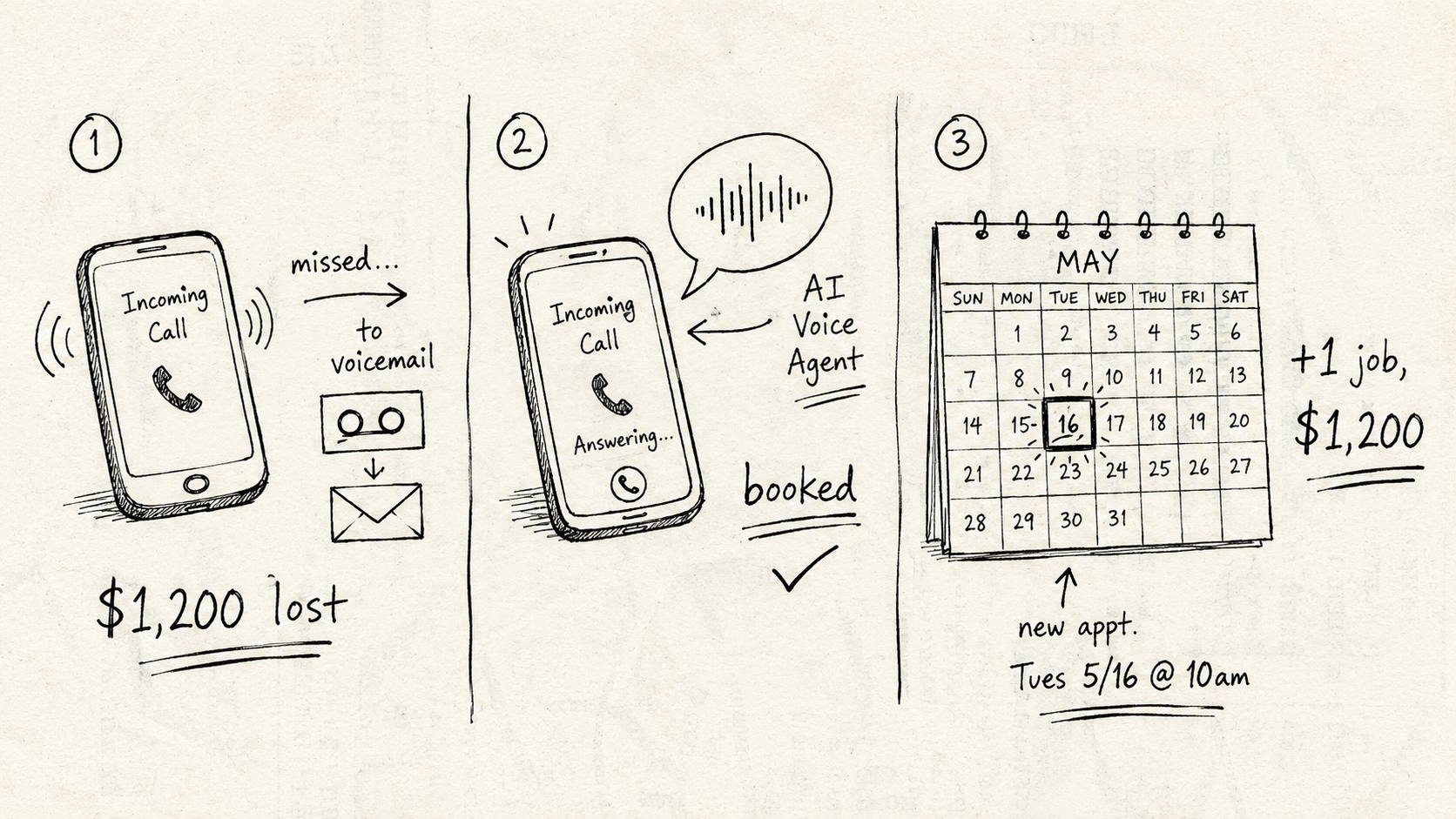 This is why I keep telling owners: pick the one place you’re bleeding the most, plug that hole, and don’t worry about anything else for 90 days. Phones first. Follow-up second. Reviews third. The fourth, fifth, and sixth wait until the first three are running clean.
That’s the Five-Pillar Revenue Audit we run for service businesses. We don’t sell AI. We find the hole. AI is one of the tools we use to plug it.
If you’re not sure where you’re bleeding, book a free audit and we’ll show you. No commitment. No pitch deck.
Why is now the closing window for small business AI?
Now is the closing window because the gap between owners who actually run AI and owners who don’t is widening fast. The small-to-large business adoption gap shrank from 1.8x to 1.2x between 2024 and 2025 according to SBA data. Translation: the businesses that are moving are moving fast. The ones that aren’t are getting passed.
Eighteen months ago, you could be the first in your zip code to answer every call after hours. Today, you’re competing against 2 or 3 shops that already do.
Two years from now? You’ll be late. You’ll be the guy explaining to his kid why the shop across town has 9 trucks and you still have 2.
I’m not saying that to scare anyone. I’m saying it because it’s already happening, in real markets, to real owners I’ve talked to. The window isn’t theoretical.
What’s the lowest-risk way to test AI in my business?
The lowest-risk way is a reactivation campaign on your existing customer list. We text or email the people who already bought from you, using AI to personalize the message, and we don’t charge a setup fee. The campaign either generates revenue in 14 days or it doesn’t. There’s no retainer to start.
That’s the trojan horse.
Most owners think AI is a $50,000 commitment that takes 6 months to set up. The truth is most service businesses have 200–2,000 dormant customers sitting in a CRM, and a properly written reactivation sequence can pull $5,000 to $50,000 out of that list in two weeks. We’ve watched it happen. I’ve also watched a roofing client run the same play and pull in $43,000 from a list of 740 names he hadn’t touched in 19 months.
You don’t need a strategy. You need a list and a sequence.
Then once that proves itself, you can talk about phones, follow-up, scheduling, the rest of the Five-Pillar Audit.
Frequently asked questions
What percentage of small businesses use AI in 2026?
76% of small businesses report using AI in some capacity, according to a January–February 2026 Goldman Sachs / Babson College survey. Only 14% have fully integrated AI into core operations. The U.S. Census Business Trends and Outlook Survey (cited by SBA Office of Advocacy) reports 8.8% use AI in production as of August 2025.
What’s the biggest barrier to AI adoption for small businesses?
The biggest barrier is lack of know-how and someone they trust to help. 73% of small business owners told Goldman Sachs they need more training and support to put AI to work. 46.8% list lack of knowledge as their #1 barrier. The issue isn’t access to tools. It’s knowing which tool to use first and having someone to set it up correctly.
How much money is the average small business losing by not using AI?
The average small business forfeits $126,000+ a year to unanswered calls alone, before counting slow follow-up, lost reviews, or missed appointments. Service businesses miss 27–62% of inbound calls, and 85% of those callers never call back.
What’s the easiest first AI tool for a service business?
The easiest first tool is an AI voice agent for after-hours and overflow calls. It captures revenue you’re already losing, doesn’t require staff retraining, and shows ROI inside 30 days. Service businesses miss 27–62% of inbound calls and 85% of those callers never call back, so even a moderate-quality voice agent recovers measurable revenue in the first month.
How fast should a small business respond to a new lead?
Within 5 minutes. Harvard Business Review research by James Oldroyd at MIT, analyzing 15,000 leads, found businesses responding inside 5 minutes were 100 times more likely to make contact and 21 times more likely to qualify the lead than those waiting 30 minutes. AI follow-up sequences hit that window automatically.
Is it too late for a small business to start with AI in 2026?
No, but the window is closing. The small-to-large business AI adoption gap shrank from 1.8x to 1.2x between 2024 and 2025 (SBA Office of Advocacy). Owners who get something running in 2026 still hold a real edge in their local market. Owners who wait until 2027 will be playing catch-up.
If you’re reading this and you already know you’re Tom, do the boring thing. Book the free audit. We’ll pull your actual numbers and tell you what you’re losing this month, in dollars. No retainer. No pitch deck. No 47-feature dashboard.
You’ll either hate the number or you won’t.
Either way, you’ll know.
About the author: Edem Agbley is the founder of SurgeTick Digital, an AI consulting firm that recovers revenue for service businesses doing $500K–$10M a year. He’s built AI voice agents, follow-up systems, and reactivation campaigns across home services, healthcare, and security verticals. He writes weekly on the SurgeTick blog.